Achilles tendon rupture specialist in Seoul: Recognizing an injury
The Achilles tendon connects the calf muscles to the heel and helps the foot push off during walking, running, and jumping. A rupture occurs when the tendon tears, either partially or completely. Symptoms can be mistaken for a sprain, particularly when some walking remains possible. A suspected rupture warrants prompt medical assessment because the injury needs to be distinguished from other causes of ankle and heel pain. Seoul Gunwoo Orthopedic Surgery Clinic provides orthopedic care for patients seeking assessment of foot and ankle concerns.
Signs that deserve attention
An Achilles rupture often occurs during a sudden change in movement, such as pushing off, jumping, or landing. Some people describe a popping sensation or a feeling that something struck the back of the ankle. Pain, swelling, and difficulty standing on the toes of the affected foot can follow. Symptoms are not identical for everyone, and the ability to walk does not rule out a tear. A clinician can examine the ankle and calf to determine what further assessment is needed.
The location of discomfort can also help guide an examination. Achilles injuries typically affect the back of the lower leg, above the heel, rather than only the front or sides of the ankle. The attending doctor may ask how the injury happened, whether a pop was felt or heard, and what movements are now difficult. Previous tendon symptoms and injuries are relevant as well. These details do not establish a diagnosis on their own, but they give the medical staff useful context for a physical examination. Try not to repeatedly test the injured foot by rising onto your toes while waiting for an assessment. If the injury is accompanied by severe pain, an obvious deformity, an open wound, or a cold or numb foot, seek urgent medical care.
An Achilles rupture can still be present when a person is able to walk. The mechanism of injury and a careful examination help the medical staff decide how to investigate the symptoms.
What to do before an appointment
If you suspect a rupture, limit weight-bearing and avoid running, jumping, or stretching the injured tendon. Arrange transport rather than driving if the injury could interfere with safe control of a vehicle. Resting the leg and elevating it can help manage swelling while you arrange care. If you already use a brace or walking aid, tell the attending doctor; avoid adjusting a device in a way that forces the ankle into a painful position.
Make a short note of when the injury occurred and what you were doing at the time. It is also useful to record whether you felt a pop, whether swelling appeared quickly, and whether you can put weight on the foot. Bring relevant medical records or imaging if you have them, along with a list of medicines you take. The medical staff may also ask about prior ankle problems, activity levels, and any health conditions that could influence treatment. Early assessment is more useful than trying to diagnose the injury yourself. Seek urgent care if symptoms are severe or the foot becomes numb or cold, rather than waiting for a routine visit.
How an assessment may proceed
An assessment generally begins with questions about symptoms and a physical examination of the calf, ankle, and foot. The attending doctor may compare the injured side with the other leg and check how the foot responds to movement. Imaging can help clarify an injury when clinically appropriate. Ultrasound uses sound waves to produce images of soft tissues, including tendons, and can be used as part of an ankle assessment.
Seoul Gunwoo Orthopedic Surgery Clinic lists foot and ankle ultrasound among its non-covered services. Whether imaging is appropriate depends on the examination and the question the attending doctor needs to answer. A scan should be interpreted alongside the history and physical findings; it is not a substitute for an individual assessment. Ask what the examination suggests, whether additional imaging is needed, and how the findings affect the next steps.
| Service | Published non-covered fee |
|---|---|
| Ankle ultrasound | ₩80,000–140,000 |
| Foot ultrasound | ₩80,000–140,000 |
These published fees apply to the individual ultrasound services listed, not to an Achilles repair package. Other consultation, imaging, treatment, or administrative charges are separate considerations. Before proceeding, ask which services are recommended for your case and whether a charge is covered. A clear explanation of the proposed assessment can help you decide what questions to raise before treatment begins.
Achilles tendon rupture specialist in Seoul: Treatment choices
Treatment for an Achilles tendon rupture can be surgical or non-surgical. The choice depends on the nature of the tear, the time since injury, activity needs, overall health, and the attending doctor’s assessment. Both approaches require a plan for protecting the tendon and restoring function. Seoul Gunwoo Orthopedic Surgery Clinic lists ultrasound-guided Achilles repair among its techniques. An individual consultation is needed to determine whether that approach is appropriate for a particular injury.
Understanding the treatment plan
Non-surgical treatment generally involves protecting the tendon in a boot or cast, followed by a structured rehabilitation plan. Surgical treatment involves repairing the torn tendon, with rehabilitation afterward. Neither approach is suitable for every patient, and the expected course should be discussed in the context of the examination. The attending doctor can explain how the tendon injury, daily activities, and health history affect the choice.
When discussing treatment, ask what the examination shows and what each option would involve. Useful topics include how the tendon will be protected, when weight-bearing might begin, and how progress will be monitored. The answers depend on the injury and the chosen plan. Surgery also involves considerations such as wound healing, infection, nerve injury, and the possibility of another rupture; non-surgical care also requires monitoring and carries a risk of another rupture. These considerations should be weighed with the medical staff rather than reduced to a single comparison. The treatment decision should account for both the injury and the patient’s circumstances. Ask for clarification if any part of the proposed plan, including follow-up or rehabilitation, is unclear.
Treatment is not simply a choice between an operation and a boot. The decision also includes how the tendon will be protected, monitored, and rehabilitated.
Ultrasound-guided Achilles repair
Ultrasound-guided Achilles repair is a technique listed by Seoul Gunwoo Orthopedic Surgery Clinic. Ultrasound provides images of soft tissue, which can help the attending doctor assess the tendon during care. The medical staff can explain how the technique is used and whether it is suitable after examining the injury. A listed technique should not be assumed to be the recommended treatment for every rupture.
If repair is being considered, ask the attending doctor to explain the proposed procedure in practical terms. Questions might include how the tendon will be protected afterward, what type of support may be used, and what activities should be avoided during recovery. It is also reasonable to ask about risks, follow-up visits, and the rehabilitation plan. Tell the medical staff about medicines, allergies, previous operations, and health conditions that could affect care. If you have work, caregiving, or travel commitments, discuss those as well, since mobility may be restricted during treatment. The details of a procedure and recovery plan are individualized, so an examination is the appropriate starting point for a specific recommendation.
Points to consider before treatment
Both treatment routes require attention to instructions about ankle position, weight-bearing, and follow-up. Returning to demanding activity before the tendon is ready can interfere with recovery. Changes may take time depending on individual condition, and progress should be assessed against the plan given by the attending doctor. Ask how to use a boot or walking aid correctly and what to do if discomfort or swelling changes.
After treatment, contact the medical staff if you are concerned about increasing pain, new numbness, or problems with a wound or support device. Sudden shortness of breath or chest pain requires emergency care. Pain and swelling in the calf should also be assessed promptly, as these symptoms can have more than one cause. The attending doctor can provide instructions tailored to the treatment selected.
Before agreeing to a plan, it can help to summarize it back to the medical staff: what the diagnosis is, how the tendon will be protected, when follow-up is expected, and which symptoms need attention. If surgery is recommended, ask about the procedure and its associated charges separately. A clear understanding of the next steps is particularly useful when arranging transport, work, and assistance at home.
Achilles tendon rupture specialist in Seoul: Recovery and visiting
Recovery from an Achilles tendon rupture is a gradual process. Rehabilitation commonly progresses from protection and controlled movement toward strengthening and a return to activity, but the pace depends on the injury and treatment plan. Seoul Gunwoo Orthopedic Surgery Clinic is an orthopedic clinic in Gangdong-gu, near Gangil Station. Patients can prepare for a visit by bringing relevant records and noting their symptoms, activity goals, and questions about care.
Rehabilitation and daily activities
Rehabilitation is intended to restore movement and strength while protecting the healing tendon. Depending on the treatment plan, the attending doctor may advise a period in a boot or cast and a gradual change in permitted activity. Exercises and weight-bearing should follow the instructions given for the individual injury. Avoid changing a brace setting or starting a stretching routine without guidance from the medical staff.
Everyday tasks can require planning while mobility is limited. Consider how you will manage stairs, bathing, work, and transport, and ask whether a walking aid is appropriate. If your job involves standing, lifting, or driving, describe those demands during the consultation. The same applies to sport: the medical staff need to know what activities you hope to resume so that the rehabilitation plan can be discussed in context. Follow-up appointments give the attending doctor an opportunity to assess progress and adjust instructions when appropriate. Return to activity should be guided by the medical staff’s assessment, not by pain alone. A reduction in discomfort does not necessarily mean the tendon is ready for every activity.
Recovery involves more than waiting for pain to settle. A clear rehabilitation plan and follow-up help patients understand how to protect the tendon as activity increases.
Preparing questions for the consultation
A focused list of questions can make an appointment more productive. Start with the diagnosis: ask whether the findings suggest a partial or complete tear and whether further imaging is needed. Then ask which treatment options are appropriate, what each involves, and how the choice relates to your health and activity goals. If terminology is unfamiliar, request an explanation in plain language.
Practical questions are equally important. Ask how to manage weight-bearing, whether you will need a boot or walking aid, and how follow-up and rehabilitation are organized. If a procedure is recommended, discuss its risks and expected recovery requirements. You can also ask for an explanation of charges before receiving a service. Seoul Gunwoo Orthopedic Surgery Clinic publishes non-covered fees for selected assessments, including foot and ankle ultrasound, gait analysis, and motion analysis. These are individual services rather than a quoted cost for Achilles rupture treatment. If you need an English medical certificate, discuss that request with the clinic during your visit.
Location and consultation hours
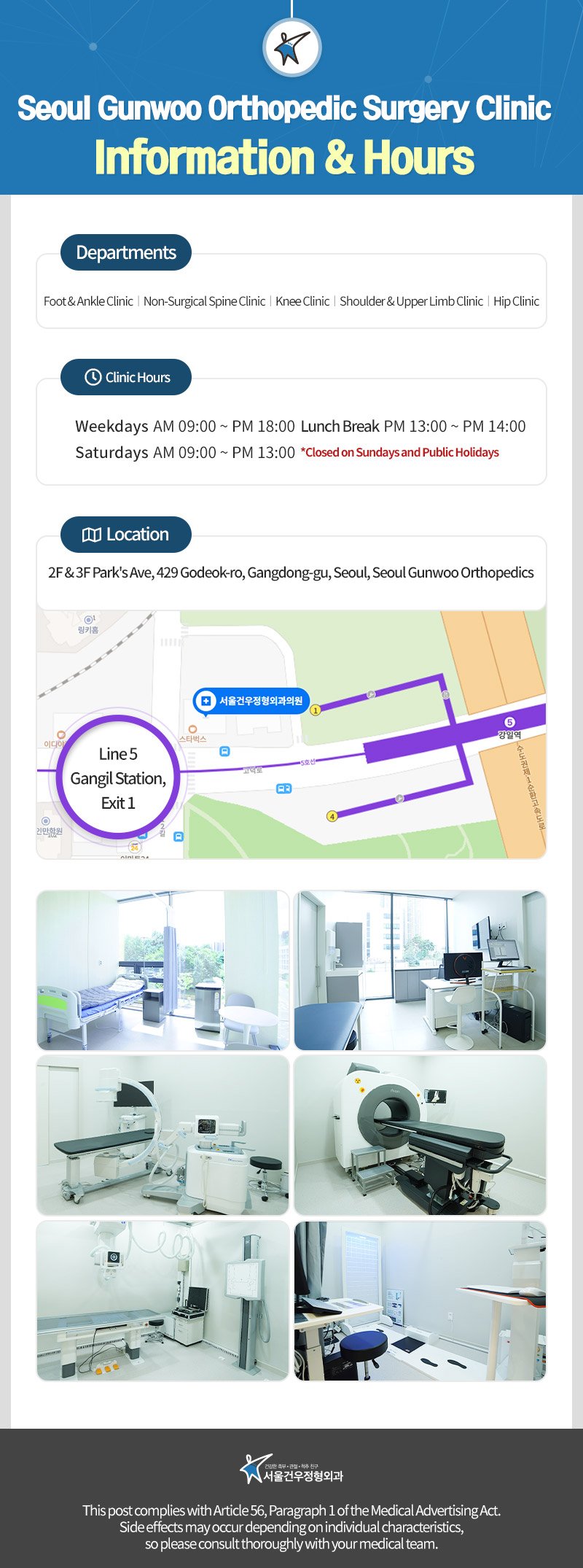
Seoul Gunwoo Orthopedic Surgery Clinic is at 2F–3F, 429 Godeok-ro, Gangdong-gu, Seoul, Republic of Korea, in front of Gangil Station Exit 1. Consultation hours are listed below in Korea Standard Time. If mobility is limited, consider arranging assistance or transport before traveling. For consultation or booking inquiries, call the clinic at 02-426-9876.
| Day | Consultation hours |
|---|---|
| Monday–Friday | 09:00–18:00; lunch break 13:00–14:00 |
| Saturday | 09:00–13:00 |
| Sunday and public holidays | Closed |
When planning a visit, bring any existing imaging or records that relate to the injury. Wear clothing that allows the lower leg and ankle to be examined, and bring a list of medicines if applicable. If you have difficulty walking, let the medical staff know when making your inquiry. For severe symptoms or concerns that need immediate attention, seek urgent medical care rather than waiting for a scheduled consultation.
A visit is an opportunity to clarify both the diagnosis and the practical demands of treatment. Ask what to do until the next appointment and how to recognize a problem that needs earlier review. Keeping those instructions accessible at home can help you follow the agreed plan and identify questions for your next conversation with the medical staff.
Frequently Asked Questions
Q.What kind of care does Seoul Gunwoo Orthopedic Surgery Clinic provide?
A.Seoul Gunwoo Orthopedic Surgery Clinic provides orthopedic care. Its listed techniques include ultrasound-guided Achilles repair.
Q.Who might seek an assessment for an Achilles injury?
A.A person with sudden pain or weakness at the back of the ankle, especially after pushing off or landing, should seek medical assessment for a possible Achilles injury.
Q.What treatment is available for an Achilles rupture?
A.Seoul Gunwoo Orthopedic Surgery Clinic lists ultrasound-guided Achilles repair among its techniques. The appropriate treatment depends on an individual assessment.
Q.How much does an ankle ultrasound cost?
A.The published non-covered fee for an ankle ultrasound is ₩80,000–140,000. This is an individual service fee, not a price for Achilles rupture treatment.
Q.How can I contact Seoul Gunwoo Orthopedic Surgery Clinic?
A.The clinic is in front of Gangil Station Exit 1. Call 02-426-9876 for consultation or booking inquiries.
Clinic Information
| Clinic | Seoul Gunwoo Orthopedic Surgery Clinic |
|---|---|
| Specialty | Orthopedics |
| Address | 2F-3F, 429, Godeok-ro, Gangdong-gu, Seoul, Republic of Korea |
| Phone | 02-426-9876 |
| Website | https://seoulfoot.sillajewelry.com |
| Specialist | Specialist care |
 Seoul Gunwoo Orthopedic Surgery Clinic