Seoul Bunion Surgery Hospital Recommendation: Understanding Your Options
A bunion is a change in the alignment of the big toe that can create a prominent bump at its base. Pain, difficulty finding comfortable shoes, and changes in walking can prompt an orthopedic consultation. Surgery is not automatically necessary because a bunion is visible: treatment decisions depend on symptoms, examination findings, and the effect on daily life. Seoul Gunwoo Orthopedic Surgery Clinic focuses on foot and ankle conditions and lists bunion correction among its areas of care.
When to seek an orthopedic assessment
Consider an assessment if pain at the base of the big toe persists, footwear regularly presses against the joint, or the toe’s position makes walking uncomfortable. An appointment can also be useful when a bunion interferes with work, exercise, or other activities. Describe where the pain occurs and whether it appears only in shoes or also when you are barefoot. These details give the attending doctor a clearer picture of the problem than the appearance of the foot alone.
It is helpful to explain how long the symptoms have been present and what you have already tried. Wider shoes, changes in activity, and protective padding are examples of measures that may reduce pressure, although they do not necessarily correct the underlying alignment. If you have pain elsewhere in the foot or ankle, mention that too. The attending doctor can assess the foot and discuss whether additional evaluation is appropriate. The purpose of the consultation is to connect the treatment plan to your symptoms and priorities. A person seeking relief from occasional shoe pressure may have different needs from someone whose pain limits walking. Be clear about your goals, including the activities you hope to return to and any concerns about taking time away from work or daily responsibilities.
A bunion assessment starts with more than the shape of the toe. The important question is how the condition affects comfort and function, and which treatment fits those findings.
Non-surgical care and its role
Non-surgical care generally focuses on reducing irritation and managing symptoms. Shoes with a roomy toe box can lessen pressure on the prominent joint, while padding may help protect an area that rubs against footwear. Depending on the individual assessment, the attending doctor may discuss other ways to manage discomfort. These approaches can be useful when symptoms are manageable or when a person wants to understand alternatives before considering an operation.
It is important to distinguish symptom relief from structural correction. A change in footwear may make walking more comfortable, but it should not be understood as a way to straighten the toe permanently. If symptoms continue despite practical adjustments, a further discussion about treatment may be appropriate. Conversely, an operation should be considered in the context of the whole foot, the severity of symptoms, and the person’s circumstances—not simply because a bump is present. Ask what a proposed non-surgical approach is intended to accomplish and how to judge whether it is helping. Bring up any recurring skin irritation or difficulty with particular shoes so the discussion can address the situations that matter most to you.
Questions to bring to your visit
Before your appointment, make a short list of your symptoms and the activities affected. Note whether pain is constant or occurs mainly with pressure, and bring information about any previous foot treatment. If certain shoes consistently cause discomfort, describing their fit can be useful. You can also ask whether the pain appears to come from the bunion itself or whether another issue needs consideration.
If surgery is raised as an option, ask what the operation is intended to correct, which technique is being considered, and why it suits your assessment. Discuss the expected recovery process, potential complications, and any practical restrictions. A useful consultation leaves room for both medical questions and everyday concerns, including footwear, mobility, and the timing of a return to activity.
Seoul Gunwoo Orthopedic Surgery Clinic’s published focus also includes ankle ligament conditions, ankle fractures, Achilles tendon problems, ankle cartilage, and ankle arthritis. If your discomfort extends beyond the big toe, describe the full pattern rather than concentrating only on the visible bump. The attending doctor can then consider the information in the context of your individual examination.
Seoul Bunion Surgery Hospital Recommendation: Procedures and Planning
Seoul Gunwoo Orthopedic Surgery Clinic names MICA minimally invasive bunion surgery among its techniques. Bunion surgery aims to address the alignment of the big toe and the associated deformity, but the appropriate procedure depends on the findings in each case. The term “minimally invasive” describes an operative approach; it does not mean that every patient will have the same recovery or outcome. Ask the attending doctor how the proposed approach relates to your particular foot and symptoms.
Understanding MICA surgery
MICA is a minimally invasive approach used for bunion correction. In general, minimally invasive bunion techniques use smaller incisions and instruments to perform the planned correction. The exact operative steps and fixation approach depend on the procedure chosen and the patient’s condition. Seoul Gunwoo Orthopedic Surgery Clinic lists MICA among its named techniques, but an examination is needed to discuss whether it is appropriate for an individual patient.
When discussing MICA, ask the attending doctor what needs to be corrected and how the correction will be maintained. It is also reasonable to ask how the approach compares with other options for your foot, what type of anesthesia is planned, and what follow-up will involve. A smaller incision is only one feature of an operation; the overall plan should also account for alignment, healing, and the demands of daily life. Seoul Gunwoo Orthopedic Surgery Clinic also lists absorbable screws for bunion and fracture fixation. Whether a fixation device is appropriate is a decision for the attending doctor and patient to discuss during treatment planning. Do not assume that a particular device or technique will be used in every case.
MICA is one approach to bunion correction, not a universal treatment plan. Ask how the proposed procedure addresses your own symptoms and what its recovery requirements will mean for you.
Points to consider before treatment
Bunion surgery may help address painful deformity when an operation is appropriate, but it also involves choices and risks that deserve a clear discussion. Possible complications of foot surgery can include infection, swelling, nerve irritation, stiffness, or a recurrence of the deformity. The attending doctor can explain which concerns are relevant to your case and how they are monitored. Changes and recovery may take time depending on your individual condition and the procedure performed.
Before deciding, discuss any medical conditions, medications, allergies, or previous reactions to anesthesia with the attending doctor. Ask what preparation is needed and whether there are medicines or activities you should adjust. Recovery instructions can differ, so clarify when you may put weight on the foot, what footwear or support might be needed, and when follow-up visits are planned. Arrange practical support for tasks that could be difficult while mobility is limited. Rather than relying on a general recovery estimate, ask for a plan tailored to your procedure and circumstances. If a proposed restriction would affect your work or home life, raise it before scheduling so you can make an informed decision.
Fees and consultation planning
The cost of bunion surgery depends on the treatment plan. Ask for an explanation of the expected charges before proceeding, including the operation, any relevant tests, and follow-up care. A published fee for an individual test or service should not be mistaken for the total cost of surgery. Coverage and out-of-pocket responsibilities should also be discussed in relation to your circumstances.
Seoul Gunwoo Orthopedic Surgery Clinic publishes non-covered fees for selected services. The amounts below apply only to the named services; they are not a bunion surgery package. A test is not necessarily required simply because it appears in the fee list.
| Published non-covered service | Fee |
|---|---|
| Foot ultrasound | ₩80,000–140,000 |
| Gait analysis | ₩50,000 |
| English medical certificate | ₩20,000 |
If you need medical documentation in English, ask about the certificate when arranging your visit. For a surgical estimate, request an itemized explanation rather than adding individual published fees together. The attending doctor can discuss which assessments are relevant after reviewing your symptoms and examining your foot. This helps separate the cost of a particular service from the broader decisions involved in treatment.
Seoul Bunion Surgery Hospital Recommendation: Recovery and Visiting
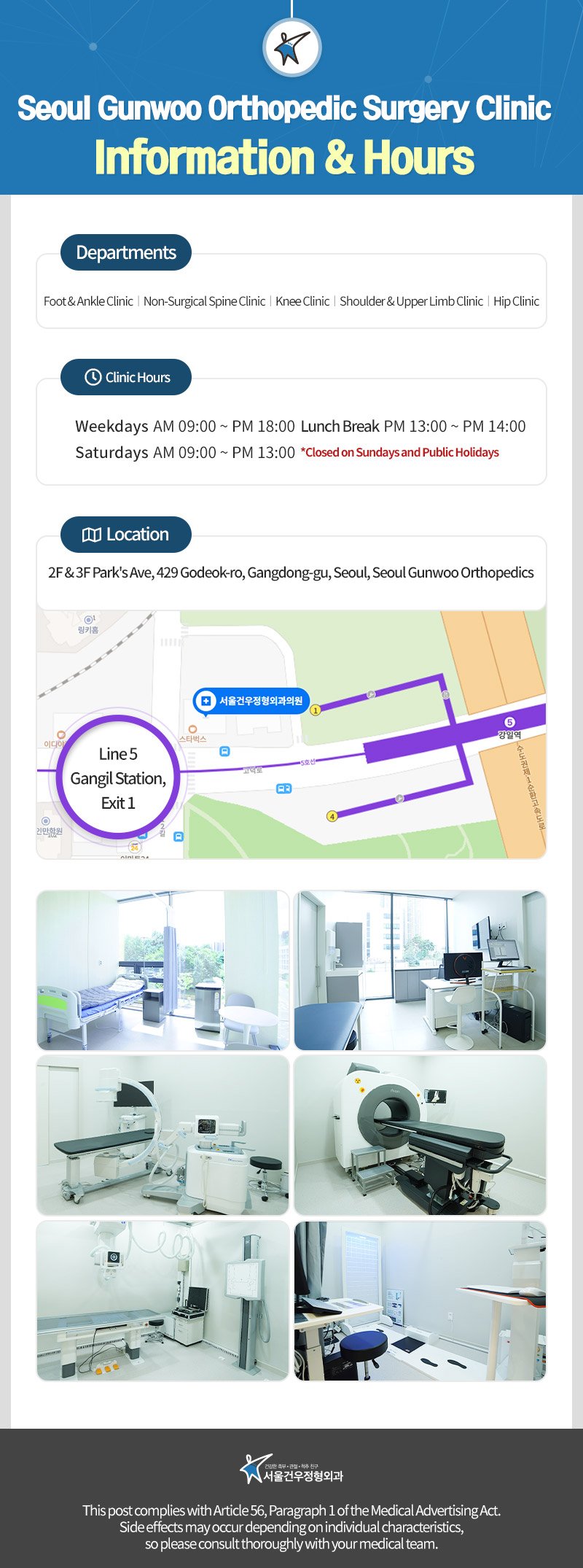
Planning for recovery is part of deciding whether bunion surgery fits your circumstances. The attending doctor’s instructions should guide wound care, mobility, footwear, and follow-up after an operation. Before the procedure, discuss your home setting and the activities you need to manage. Ask for instructions specific to your operation rather than assuming that every bunion procedure has the same recovery plan. Seoul Gunwoo Orthopedic Surgery Clinic is located in Gangdong-gu, near Gangil Station.
Preparing for recovery at home
Consider how you will move around your home and manage routine tasks if walking is temporarily limited. It may help to plan transportation, arrange assistance with shopping or household work, and keep frequently used items within easy reach. Ask the attending doctor whether you will need a support device or special footwear and how to use it. Any equipment or restrictions should be discussed as part of your individual plan.
Before leaving after treatment, make sure you understand how to care for the surgical area, what medicines to take, and whom to contact if a concern arises. Ask when dressings may be changed and whether you should keep the foot dry. Swelling and discomfort can be part of recovery, but the attending doctor should explain which changes warrant a call. Seek prompt medical advice for concerning symptoms such as worsening pain, fever, or increasing redness around a wound. If you experience severe shortness of breath or chest pain, seek emergency care. Follow-up appointments provide an opportunity to review healing and ask when activities can be resumed; keep the schedule provided by the medical staff.
Recovery planning should begin before the operation, not after it. Clear instructions about mobility, wound care, and follow-up can help you prepare for the practical demands of healing.
Returning to footwear and activity
A return to regular shoes, exercise, and longer walks depends on the procedure and how healing progresses. Ask the attending doctor what milestones will guide those decisions and whether your work involves standing, walking, or lifting. If you have travel plans, discuss them before arranging surgery. A personalized plan is more useful than assuming a fixed timetable based on another person’s experience.
Footwear remains an important topic after treatment. Ask what type of shoe is suitable at each stage and when a wider toe box or other support may be helpful. As activity increases, report pain or swelling that is worsening or that concerns you. The medical staff can explain whether an adjustment in activity or an assessment is appropriate. Follow the instructions given for your own operation rather than trying to accelerate recovery because an incision looks small. Comfort, function, and healing should all be considered when planning the next step. If your goals include a particular sport or demanding job, mention that early so you can discuss a sensible approach to returning.
Arranging an appointment
Seoul Gunwoo Orthopedic Surgery Clinic is in front of Gangil Station Exit 1. Consultation hours are Monday through Friday from 9:00 a.m. to 6:00 p.m., with a weekday lunch break from 1:00 p.m. to 2:00 p.m. Saturday hours are 9:00 a.m. to 1:00 p.m. The clinic is closed on Sundays and public holidays. Hours are in Korea Standard Time.
When arranging a visit, explain that you would like an assessment for a bunion and mention any difficulty walking or wearing shoes. Ask whether to bring previous examination records or images if you have them. If you need an English medical certificate, raising the request in advance can help you understand the process. Prepare your questions about treatment options, recovery, and expected charges before the appointment.
A consultation is also an opportunity to discuss concerns that may affect treatment decisions, such as your schedule, support at home, and previous attempts to manage symptoms. The goal is to leave with a clear understanding of the next step, whether that is continued symptom management, further assessment, or a discussion of surgery. Take time to ask for clarification if any part of the proposed plan is unclear.

Frequently Asked Questions
Q.What kind of care does Seoul Gunwoo Orthopedic Surgery Clinic offer?
A.Seoul Gunwoo Orthopedic Surgery Clinic is an orthopedic clinic focused on foot and ankle conditions. Its published areas of care include bunion correction, ankle ligament surgery, Achilles tendon repair, and ankle arthritis.
Q.Who might consider an appointment for a bunion?
A.An assessment may be useful for someone with pain at the base of the big toe, difficulty wearing shoes, or discomfort that affects walking. The attending doctor can discuss treatment in light of the symptoms and examination.
Q.Does Seoul Gunwoo Orthopedic Surgery Clinic offer minimally invasive bunion surgery?
A.Seoul Gunwoo Orthopedic Surgery Clinic lists MICA minimally invasive bunion surgery among its techniques. Whether it is appropriate depends on the individual assessment.
Q.How much does bunion surgery cost?
A.The cost depends on the treatment plan. Ask for an explanation of the expected charges, including any relevant tests and follow-up care.
Q.Where is Seoul Gunwoo Orthopedic Surgery Clinic, and how can I contact it?
A.Seoul Gunwoo Orthopedic Surgery Clinic is at 2F–3F, 429 Godeok-ro, Gangdong-gu, Seoul, Republic of Korea, in front of Gangil Station Exit 1. Call 02-426-9876 to discuss an appointment.
Clinic Information
| Clinic | Seoul Gunwoo Orthopedic Surgery Clinic |
|---|---|
| Specialty | Orthopedics |
| Address | 2F-3F, 429, Godeok-ro, Gangdong-gu, Seoul, Republic of Korea |
| Phone | 02-426-9876 |
| Website | https://seoulfoot.sillajewelry.com |
| Specialist | Specialist care |
 Seoul Gunwoo Orthopedic Surgery Clinic