
Ankle Ligament Reconstruction Reviews Seoul: What to Look For
Patient reviews can help you prepare questions about ankle ligament care, but a review is not a medical assessment. Ankle instability has different causes, and treatment depends on the injury, symptoms, examination findings, and individual circumstances. Seoul Gunwoo Orthopedic Surgery Clinic provides orthopedic care for ankle ligament concerns, and its published surgical work includes ligament repair and reconstruction. The most useful reviews describe the patient’s experience without implying that the same treatment or outcome applies to everyone. Read them alongside a consultation rather than using them as a substitute for one.
Read Beyond the Overall Rating
A rating gives a quick impression, but the details often matter more. Look for an explanation of why the reviewer sought care, what questions were discussed, and how the recovery experience was described. A comment about feeling informed can be helpful when you are deciding what to ask at an appointment. By contrast, a short statement that treatment was “good” offers little information about the injury or the care provided. Neither a positive nor a negative rating establishes whether reconstruction is appropriate for your ankle.
Pay attention to the distinction between the experience of care and the clinical outcome. A reviewer may describe scheduling, communication, or comfort during a visit; those details can be relevant to your practical planning. A clinical outcome, however, depends on factors that a review may not fully explain, such as the extent of ligament damage, other ankle injuries, and rehabilitation. It is also worth checking whether the account refers to an initial consultation, an operation, or a later stage of recovery. These are different parts of care and should not be treated as interchangeable. Use a review to identify questions, not to diagnose yourself. If a review leaves out the treatment or recovery context, avoid drawing broad conclusions from it. The attending doctor can help relate your own symptoms and goals to the options discussed at consultation.
Reviews are most useful when you can tell what care the writer received and when the experience was reported. They can inform your questions, but your treatment decision needs an assessment of your own ankle.
Distinguish Repair From Reconstruction
Ligament repair and ligament reconstruction are related but distinct surgical approaches. Repair generally involves working with the existing injured ligament, while reconstruction uses tissue to restore ligament support. The choice depends on the condition of the ligament and other clinical factors. A review that uses the word “surgery” without naming the procedure does not tell you which approach was used. Seoul Gunwoo Orthopedic Surgery Clinic’s published surgical work covers both ankle ligament repair and reconstruction.
When comparing accounts, ask whether the reviewer explains why surgery was discussed and whether other treatment had already been considered. Persistent symptoms after an ankle injury do not automatically mean that reconstruction is needed. Depending on the assessment, the attending doctor may discuss rehabilitation or other nonsurgical measures, as well as surgical options when appropriate. A reviewer’s description of one approach should not be interpreted as a recommendation for another person. If surgical care is being considered, useful questions include what the procedure is intended to address, how the proposed approach differs from an alternative, and what recovery would involve. Understanding the reason for a recommendation is more useful than assuming a named procedure is suitable for every unstable ankle.
Consider the Timing of a Review
Recovery is a process, so the timing of a review matters. An account written soon after an operation may focus on communication, comfort, and early instructions. A later account may describe a return to walking, work, or exercise. Both perspectives can be informative, but neither provides a complete picture of another patient’s recovery. Changes may take time depending on individual condition, the procedure, and the rehabilitation plan.
Look for specific descriptions rather than broad promises. A reviewer who explains which activities were difficult before care and which were discussed during recovery gives you more context than someone who simply reports feeling better. Even then, activity goals differ: returning to everyday walking is not the same as returning to a sport involving rapid changes of direction. Use these distinctions to prepare questions about your own priorities.
| Review detail | How to interpret it |
|---|---|
| Reason for seeking care | Helps explain the symptoms or injury behind the visit. |
| Procedure named | Helps distinguish ligament repair from reconstruction. |
| Timing of the account | Shows whether the review describes consultation, early recovery, or a later stage. |
| Activity goals | Provides context for the reviewer’s discussion of recovery. |
It is also sensible to read a range of experiences rather than relying on a single account. Different observations can prompt useful questions about communication and recovery planning. Reviews cannot verify every medical detail or establish a likely result for you, however. Bring any concerns raised by your reading to the appointment, and ask the attending doctor how the proposed care relates to your examination and goals.
Ankle Ligament Reconstruction Reviews Seoul: Understanding Treatment
Ankle ligament reconstruction is one possible approach to ligament instability, not a routine response to every sprain. An assessment considers the symptoms and the history of the injury before treatment options are discussed. At Seoul Gunwoo Orthopedic Surgery Clinic, ankle ligament care forms part of the clinic’s orthopedic services. The clinic’s published surgical work also covers ankle cartilage, ankle arthritis, and fractures. Those topics are relevant because ankle pain or instability can have more than one contributing cause.
When to Seek an Assessment
An ankle that repeatedly gives way, remains painful, or limits everyday activities deserves medical attention. Tell the attending doctor how the injury occurred, whether it has happened before, and which movements bring on symptoms. An assessment can help clarify whether the problem is related to ligament instability or another condition. If an injury causes marked deformity, a cold or numb foot, or an inability to bear weight, seek prompt medical evaluation rather than waiting for a routine review of symptoms.
Before the appointment, it can help to make a brief record of your symptoms. Note whether the ankle feels unstable on uneven ground, during exercise, or in ordinary daily activity. If swelling or pain changes with activity, describe that pattern as clearly as you can. Bring relevant previous test results or treatment records if you have them, along with a list of medicines you take. These details give the attending doctor context for the discussion; they do not replace an examination. You can also describe the activities you hope to resume and any concerns about surgery or rehabilitation. A clear account of your symptoms helps make the consultation more focused. The doctor can then explain what further assessment or treatment discussion is appropriate for your situation.
The decision begins with the ankle problem, not with a procedure name or an online rating. A detailed injury history and examination help frame the discussion of treatment options.
How Treatment Options Are Discussed
Treatment depends on the clinical findings and the effect symptoms have on daily life. For some ankle ligament problems, nonsurgical care may be discussed before surgery. If instability persists or the findings warrant a surgical discussion, the attending doctor can explain whether repair or reconstruction is appropriate to consider. Ask what each proposed option is intended to address and how progress would be assessed. A treatment plan should be understood in the context of your own injury and goals.
If reconstruction is proposed, ask the doctor to explain the planned approach in plain language. Questions might include why the existing ligament requires reconstruction, whether another ankle problem also needs attention, and what preparation is needed before treatment. It is reasonable to ask about the expected stages of recovery and the support you may need at home or at work. Discuss any medicines, health conditions, and previous ankle care that could affect planning. The doctor can also explain relevant risks and alternatives for your case. There is no need to decide on the basis of a review alone: the purpose of the consultation is to understand the reasoning behind a recommendation and to make an informed choice about the next step.
Points to Consider Before Treatment
All surgical procedures involve considerations that should be discussed with the attending doctor. For ankle ligament reconstruction, the conversation can include wound healing, infection, stiffness, ongoing discomfort, and the possibility that instability or symptoms may persist. The relevance of each concern depends on the individual and the proposed procedure. Ask which signs should prompt you to contact the medical staff after treatment and what instructions would apply to your recovery.
Rehabilitation is another important part of the discussion. Depending on the procedure and your condition, the doctor may provide guidance on protecting the ankle, bearing weight, and gradually returning to activity. Ask how the plan will be tailored to your work, home responsibilities, and exercise goals. Changes may take time depending on individual condition, so a review describing another person’s progress should not be treated as your schedule.
| Consultation topic | Question to ask |
|---|---|
| Diagnosis | What is causing the instability or pain? |
| Options | Why is this treatment being recommended? |
| Recovery | What activities should I plan around during recovery? |
| Follow-up | Which symptoms should prompt me to contact the medical staff? |
It can be useful to write down the answers or bring someone with you to help remember the discussion. Ask for clarification if a term or instruction is unfamiliar, especially when it concerns medicines, mobility, or follow-up. If cost is part of your decision, ask for an explanation of the charges associated with the proposed care. Exact pricing depends on the assessment and treatment plan.
Ankle Ligament Reconstruction Reviews Seoul: Planning Your Visit
Preparing for an orthopedic consultation is often more useful than trying to match your symptoms to a reviewer’s account. Gather your injury history, relevant records, and questions about the activities that matter to you. Seoul Gunwoo Orthopedic Surgery Clinic provides ankle ligament care alongside care for bunions, Achilles tendon concerns, heel pain, and plantar fasciitis. Its published surgical work covers a range of foot and ankle conditions, including ankle ligament repair and reconstruction.
Make Your Questions Specific
Start with the concern that affects you most. For example, explain whether your ankle gives way, hurts during walking, or prevents you from returning to a particular activity. Then ask what the examination suggests and whether further assessment is needed. Specific questions make it easier to understand how a recommendation relates to your condition. If you have read reviews, bring the questions they raised rather than assuming the same procedure or recovery experience will apply to you.
It is helpful to separate questions into diagnosis, treatment, and recovery. Under diagnosis, ask what structures may be involved and whether another condition could be contributing to symptoms. Under treatment, ask about the alternatives and the reasoning behind any recommendation. Under recovery, ask what support or adjustments you may need for daily activities. If you have a particular concern about work, caregiving, exercise, or travel, mention it early in the conversation. The aim is to leave with a clear understanding of the proposed next step and what it means for your circumstances. If you need more time to consider a treatment decision, ask what information would help you make it. A written list of questions can keep the conversation focused without relying on memory.
A useful consultation connects the diagnosis, treatment options, and recovery plan to the activities you value. Specific questions help you understand the recommendation instead of relying on another patient’s experience.
Know What the Clinic Covers
Seoul Gunwoo Orthopedic Surgery Clinic provides orthopedic care that includes ankle ligament concerns. Its published surgical work covers ankle ligament repair and reconstruction, as well as bunions, Achilles tendon repair, ankle cartilage, ankle arthritis, and fractures. Dr. Choi Hong Joon has a background in foot and ankle medicine, clinical practice, and research. Dr. Min Kyong Dae’s profile includes orthopedic, arthroscopy, and sports-medicine training.
These areas of care can provide context when you are looking for help with a foot or ankle concern. They do not establish which treatment you need or whether surgery is appropriate. For example, an ankle that feels unstable may require a different discussion from heel pain, and a history of repeated sprains may be relevant to the assessment. Describe your own symptoms rather than selecting a procedure in advance. If you have previously received care, bring the records you have and explain which measures helped or did not help. The attending doctor can use that history, together with the examination, to discuss appropriate next steps. When reading about surgical work, remember that a published topic describes an area of care; it is not a prediction of an individual outcome.
Arrange the Practical Details
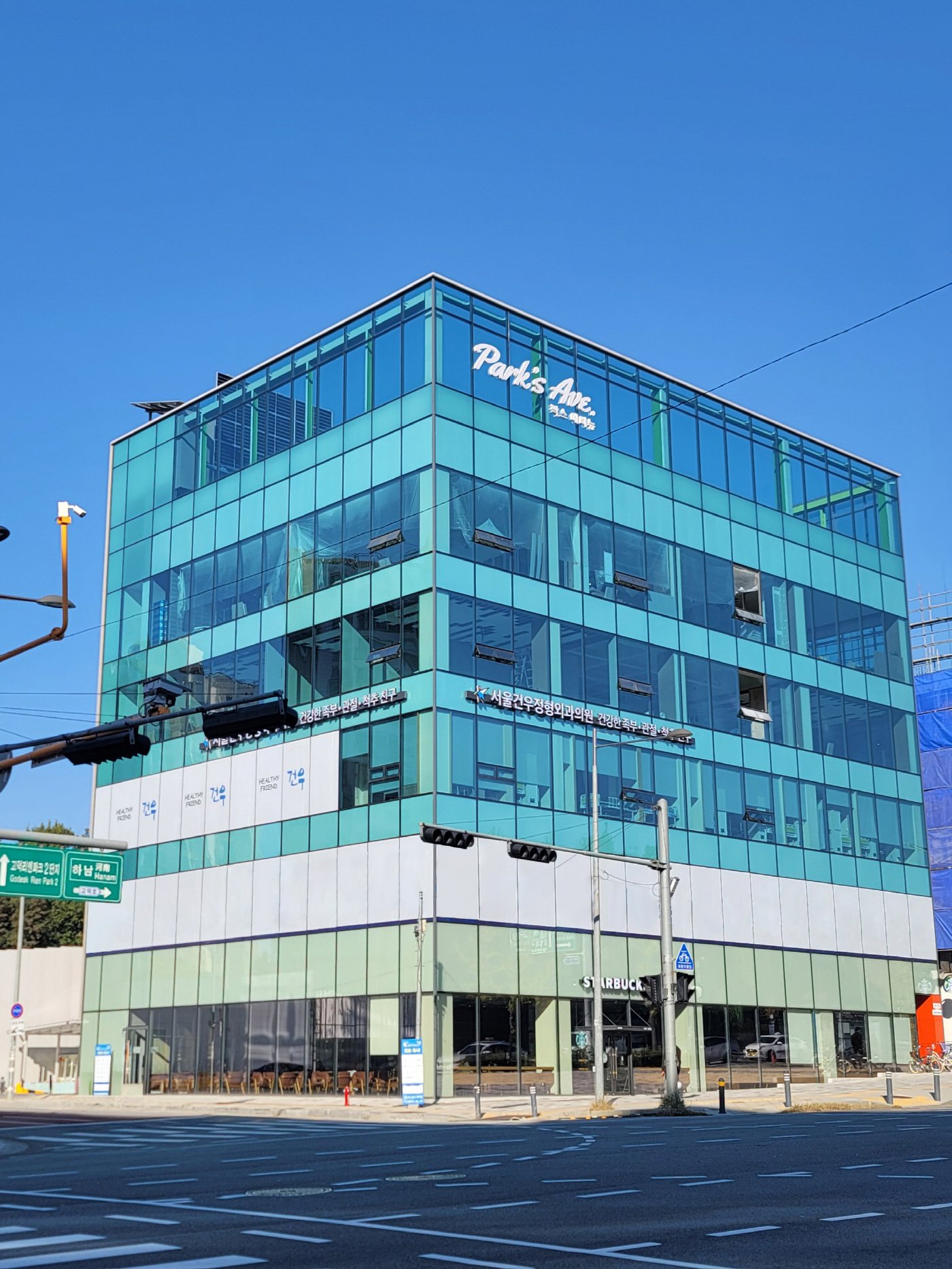
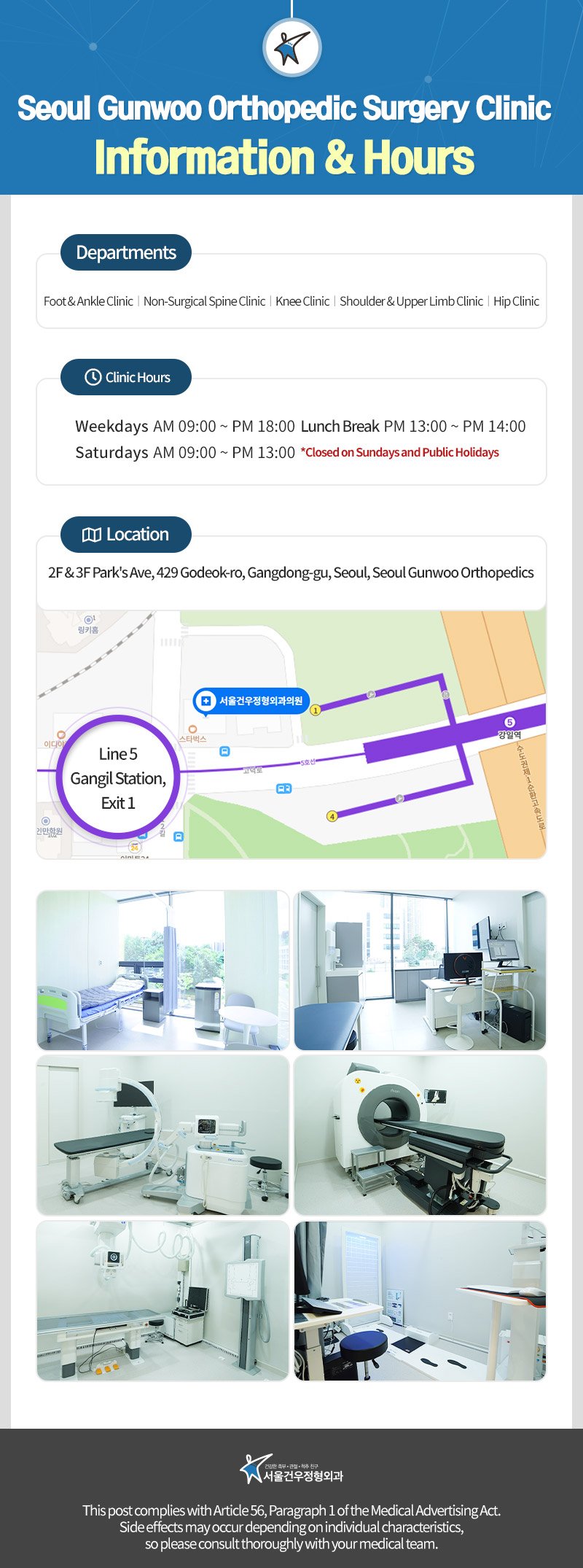
Seoul Gunwoo Orthopedic Surgery Clinic is at 2F–3F, 429 Godeok-ro, Gangdong-gu, Seoul, Republic of Korea, near Gangil Station, Exit 1. Consultation hours are listed below in Korea Standard Time. Planning around the weekday lunch break can make the visit easier to organize. For consultation and booking inquiries, call 02-426-9876.
Before visiting, gather any relevant imaging reports or treatment notes you already have. You may also want to wear clothing and footwear that allow the ankle to be examined comfortably. If walking is difficult, consider how you will travel to and from the appointment. Bring your questions about diagnosis, treatment, and recovery so that the discussion addresses your immediate concerns.
| Day | Consultation hours |
|---|---|
| Monday–Friday | 09:00–18:00; lunch break 13:00–14:00 |
| Saturday | 09:00–13:00 |
| Sunday and public holidays | Closed |
After the consultation, review the proposed next steps and ask about anything that remains unclear. If treatment is recommended, make sure you understand the purpose of the plan, any preparation, and the follow-up instructions. If further assessment is advised, ask how it will help clarify the diagnosis. A careful discussion is more informative than comparing recovery claims without knowing the circumstances behind them.

Frequently Asked Questions
Q.What kind of care does Seoul Gunwoo Orthopedic Surgery Clinic provide?
A.Seoul Gunwoo Orthopedic Surgery Clinic provides orthopedic care, including ankle ligament care. Its published surgical work includes ankle ligament repair and reconstruction.
Q.Who should consider an ankle ligament consultation?
A.A consultation can be useful for someone whose ankle repeatedly gives way, remains painful, or limits daily activities after an injury. An assessment helps clarify the cause and guide the discussion of care.
Q.Does Seoul Gunwoo Orthopedic Surgery Clinic address conditions other than ankle ligament injuries?
A.Yes. The clinic also provides care for bunions, Achilles tendon concerns, heel pain, and plantar fasciitis; its published surgical work includes ankle cartilage, ankle arthritis, and fractures.
Q.What should I bring to an ankle consultation?
A.Bring relevant previous imaging reports or treatment records if you have them, along with a list of medicines and questions about your symptoms. A brief injury history can also help focus the discussion.
Q.How can I arrange a visit to Seoul Gunwoo Orthopedic Surgery Clinic?
A.Contact Seoul Gunwoo Orthopedic Surgery Clinic for consultation and booking inquiries. The clinic is near Gangil Station, Exit 1.
Clinic Information
| Clinic | Seoul Gunwoo Orthopedic Surgery Clinic |
|---|---|
| Specialty | Orthopedics |
| Address | 2F-3F, 429, Godeok-ro, Gangdong-gu, Seoul, Republic of Korea |
| Phone | 02-426-9876 |
| Website | https://seoulfoot.sillajewelry.com |
| Specialist | Specialist care |
 Seoul Gunwoo Orthopedic Surgery Clinic