
Choosing an Ankle ligament reconstruction specialist in Seoul
Repeated ankle sprains or a continuing sense that the ankle may give way warrant a careful assessment, but they do not automatically mean reconstruction is needed. At Seoul Gunwoo Orthopedic Surgery Clinic, ankle ligament care is part of the clinic’s orthopedic services, and its published surgical work includes ligament repair and reconstruction. The purpose of an initial consultation is to understand the symptoms, review relevant history, and discuss an appropriate plan. Surgery is a decision made for an individual case, not a default response to every ankle sprain.
What an initial consultation can clarify
An appointment can help distinguish ongoing instability from pain or other concerns around the ankle. Be ready to describe when symptoms began, whether sprains have recurred, and which activities bring on discomfort or a feeling of giving way. Mention any care already received and how symptoms have changed over time. These details give the medical staff useful context for considering next steps. A clear account of your symptoms is a practical starting point for a focused discussion.
The assessment should connect your symptoms with your ankle history and current concerns. The medical staff can discuss whether ligament care is relevant and whether a surgical option merits consideration. Seoul Gunwoo Orthopedic Surgery Clinic’s published work includes both ankle ligament repair and reconstruction, but the procedure that may suit a particular person depends on the clinical assessment. Ask what the proposed approach is intended to address, what alternatives may be appropriate, and what further discussion or evaluation is needed. A consultation is also an opportunity to explain your usual activities and priorities, so the care plan can account for what you hope to return to.
Persistent instability deserves an assessment, but it does not make surgery inevitable. The key is to connect your symptoms and ankle history to a clear discussion of whether reconstruction is appropriate.
Orthopedic experience and foot and ankle care
The clinic provides orthopedic care that includes foot and ankle concerns. Its profile describes Dr. Choi Hong Joon’s background in foot and ankle medicine, clinical practice, and research, as well as a Doctor of Philosophy in Medicine from Korea University and a fellowship at Seoul Foot Center, Inje University Seoul Paik Hospital. This context may help patients understand the clinic’s experience in the field, while a consultation remains necessary to discuss an individual ankle problem.
The clinic profile also describes Dr. Min Kyong Dae’s orthopedic, arthroscopy, and sports-medicine training. It lists orthopaedic specialist training at Severance Hospital, Yonsei University, arthroscopy research experience there, an adjunct professorship at Yonsei University, and a fellowship at Stanford University Sports Center. These details provide background on the listed clinical experience; they do not replace an individual assessment or determine which procedure is suitable. When discussing ankle instability, ask how the assessment relates to your symptoms and whether repair, reconstruction, or another course of care is being considered. A useful consultation should make the reasoning understandable and leave room for questions.
When to ask about reconstruction
Consider arranging an orthopedic consultation if ankle instability continues, sprains recur, or symptoms interfere with everyday movement or preferred activities. These concerns alone do not establish that a ligament reconstruction is needed. The medical staff can review the history and discuss whether the problem is consistent with ligament injury or whether another explanation should be considered. Seek timely medical advice for significant or worsening symptoms rather than relying on self-assessment.
Before the appointment, make a short note of the episodes that best describe the problem: when they occurred, what you were doing, and what you felt afterward. Include relevant details about previous ankle injuries and care. This does not need to be a formal record; the goal is to help you explain the pattern clearly. During the consultation, ask what the assessment indicates and what options are relevant in your case. Knowing the reason for each proposed next step can make treatment decisions easier to follow.
Try to frame the visit around function as well as pain. Tell the medical staff whether the ankle feels unreliable on uneven ground, during exercise, or in ordinary daily movement, if those situations apply to you. The more clearly you describe the problem, the more focused the conversation can be. The appropriate plan depends on clinical findings and your circumstances, so avoid assuming that a particular procedure will be recommended before the assessment.
Understanding Ankle ligament reconstruction specialist in Seoul care options
Ankle ligament care can involve assessment and discussion of treatment options, including surgery when appropriate. Seoul Gunwoo Orthopedic Surgery Clinic’s published surgical work includes ankle ligament repair and reconstruction, alongside other foot and ankle procedures. These names describe available areas of surgical work, not a promise that a particular operation is suitable for every patient. The consultation should explain why a proposed option fits the findings and what questions remain before you decide.
Repair and reconstruction are not interchangeable assumptions
The clinic’s published surgical work includes both ankle ligament repair and reconstruction. The terms refer to distinct surgical approaches, but the appropriate choice cannot be determined from a symptom description alone. Your medical staff can explain which approach, if any, is being considered for your case and how that recommendation relates to your assessment. Ask for a plain-language explanation of the goal of the proposed procedure and the alternatives that may be discussed.
It is reasonable to ask what the medical staff believes is causing the instability, why surgery is being considered, and how the plan addresses your particular concerns. Also ask what further evaluation or discussion is required before making a decision. The recommendation should be understood in the context of your symptoms, medical history, and clinical assessment, rather than based only on the fact that an ankle has been sprained more than once. If the details feel unclear, request clarification before proceeding. The aim is an informed conversation about options, not pressure to choose an operation at the first visit.
Repair and reconstruction are both included in the clinic’s published ankle surgical work, but they are not automatic choices for every patient. Ask how the proposed approach relates to your assessment and what alternatives should be considered.
What to discuss when surgery is proposed
If surgery is raised as an option, ask what the procedure is intended to address and what the decision is based on. Discuss the expected care pathway, relevant preparation, and what follow-up conversations will cover. These details should be explained for your individual case rather than assumed from general descriptions of ankle surgery. Make sure you understand the plan before agreeing to a procedure.
Useful questions include what the assessment has found, why repair or reconstruction is being discussed, and whether non-surgical care or additional evaluation is relevant. Ask how your usual activities fit into the treatment discussion and what you should expect after the procedure if surgery is chosen. The medical staff can provide guidance that reflects your circumstances. Clear explanations support a more informed decision and help you know what to discuss next. If you take regular medication or have other health concerns, raise them during the consultation so they can be considered in planning care.
Other foot and ankle services at the clinic
Ankle ligament care sits within a broader range of foot and ankle services at Seoul Gunwoo Orthopedic Surgery Clinic. The clinic also lists care for bunions, Achilles tendon concerns, heel pain, and plantar fasciitis. Its published surgical work includes Achilles tendon repair, ankle cartilage, ankle arthritis, and fractures. This service range can be relevant when ankle symptoms overlap with other concerns, but the right area of care depends on the individual assessment.
For heel pain and plantar fasciitis, the clinic describes assessment, stretching, shockwave therapy, and discussion of persistent symptoms. Those services are separate from ligament reconstruction and should not be assumed to address ankle instability. If you have more than one foot or ankle concern, mention each one when booking or during the consultation. The medical staff can help identify which issue should be discussed and whether the concerns may need separate evaluation. Being specific about where you feel pain or instability helps keep the conversation focused on the problem you want assessed.
It may be helpful to describe whether your main concern is pain, repeated sprains, a feeling of instability, or another symptom. If you are unsure how to categorize it, explain what happens during movement and when it occurs. The clinic’s services include several foot and ankle concerns, so a clear description helps direct the consultation toward the relevant issue without assuming a diagnosis in advance.
Planning a visit to an Ankle ligament reconstruction specialist in Seoul
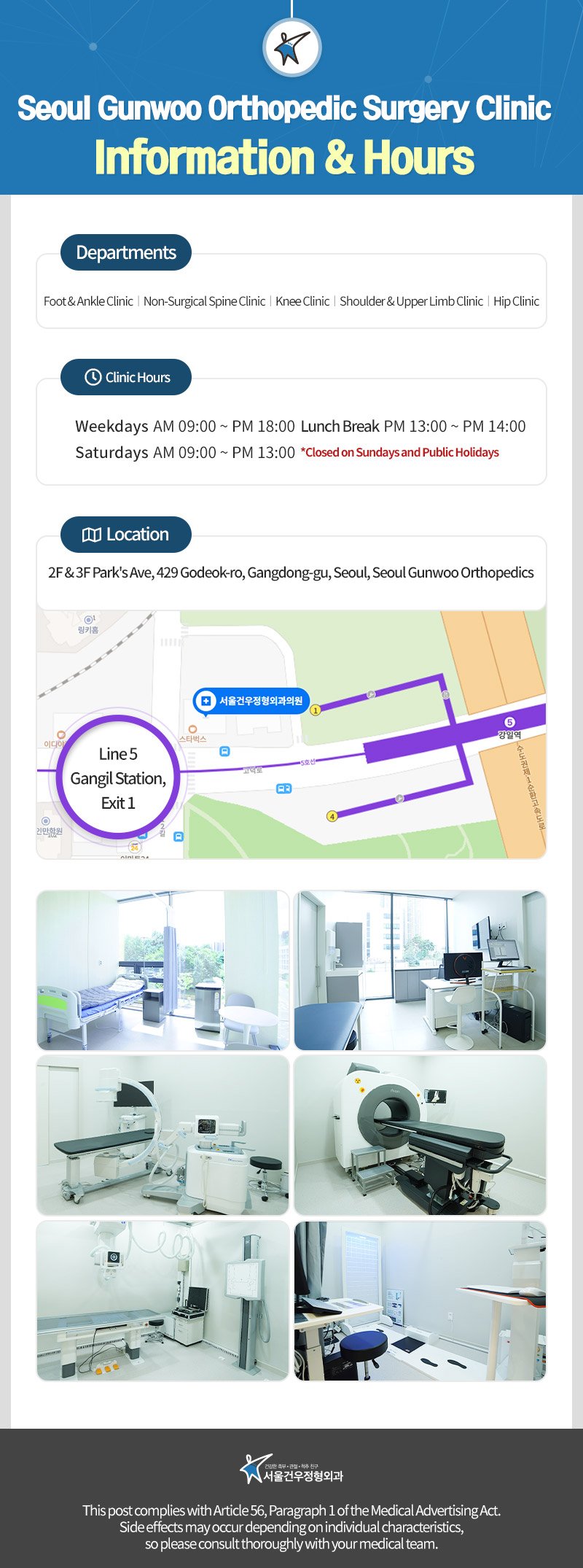
Planning ahead can make an orthopedic consultation more straightforward. Seoul Gunwoo Orthopedic Surgery Clinic is located on the second and third floors at 429 Godeok-ro, Gangdong-gu, Seoul, in front of Gangil Station Exit 1. Bring a concise history of your ankle symptoms and any questions you want answered. Use the appointment to understand the assessment and the options that apply to your situation.
What to prepare for the appointment
Before visiting, note when the ankle problem began, whether injuries have recurred, and which movements or activities bring on symptoms. Include relevant prior care and any concerns that affect your daily routine. Write down questions about assessment, treatment options, and whether surgery is being considered. These simple preparations can help you use the consultation time effectively and make it easier to remember the discussion.
You do not need to arrive with a diagnosis or a preferred procedure. Describe what you experience in your own words, including whether the ankle feels unstable or mainly painful. If you have questions about how an option fits your activities, ask directly. The medical staff can explain the next steps based on the assessment. If you are seeking care for more than one foot or ankle concern, mention each issue so it can be included in the discussion. Preparation is most useful when it helps you communicate clearly, rather than when it leads you to self-diagnose.
Location and consultation hours
The clinic is at 2F–3F, 429, Godeok-ro, Gangdong-gu, Seoul, Republic of Korea, in front of Gangil Station Exit 1. Consultation hours are Monday through Friday from 09:00 to 18:00, with a weekday lunch break from 13:00 to 14:00, and Saturday from 09:00 to 13:00. The clinic is closed on Sundays and public holidays. Hours are in Korea Standard Time.
For appointment or consultation questions, contact Seoul Gunwoo Orthopedic Surgery Clinic at 02-426-9876. When arranging a visit, briefly describe that you are seeking ankle ligament care and ask what information would be useful to bring. Planning around the weekday lunch break or the clinic’s weekend schedule can help you choose a suitable time. The address and station access provide a straightforward reference for reaching the clinic.
Before travelling, keep the address and your appointment details available. If you are managing several symptoms, note the main concern you want to discuss first. A concise description of your ankle history can make the initial conversation more efficient and help the medical staff understand what prompted the visit.
Making a considered treatment decision
A decision about ankle ligament reconstruction should follow an assessment and a clear explanation of the options. Ask what the medical staff recommends, why that option is relevant, and what other steps may be considered. If the proposed plan is not clear, ask for it to be explained in plain language. You should understand the purpose of a proposed procedure before deciding how to proceed.
Keep the discussion centered on your symptoms, goals, and concerns. The clinic’s published surgical work includes ankle ligament repair and reconstruction, but an individual recommendation depends on the case. A consultation can help clarify whether surgery is being considered and what information is needed to make an informed decision. Take time to review the explanation and raise any remaining questions with the medical staff.
A little preparation helps you explain your ankle history and ask focused questions. At the clinic, the consultation is the place to understand the assessment, location-specific details, and which care options are relevant to you.
Frequently Asked Questions
Q.What kind of care does Seoul Gunwoo Orthopedic Surgery Clinic provide for ankle ligament problems?
A.Seoul Gunwoo Orthopedic Surgery Clinic provides ankle ligament care, and its published surgical work includes ankle ligament repair and reconstruction. An orthopedic consultation can clarify which options are relevant to an individual case.
Q.Who may want to seek an ankle ligament assessment?
A.People with ongoing ankle instability, recurrent sprains, or symptoms that affect daily movement or activities may wish to arrange an orthopedic consultation. These symptoms do not by themselves establish that surgery is needed.
Q.How are ankle ligament repair and reconstruction addressed?
A.The clinic’s published surgical work includes both ankle ligament repair and reconstruction. The medical staff can discuss whether either approach is appropriate after assessing the individual situation.
Q.What should I prepare before visiting Seoul Gunwoo Orthopedic Surgery Clinic?
A.Note when symptoms began, any recurring sprains, activities that trigger symptoms, and care received so far. Consultation hours are Monday through Friday, 09:00–18:00, with a weekday lunch break from 13:00–14:00, and Saturday, 09:00–13:00.
Q.Where is Seoul Gunwoo Orthopedic Surgery Clinic, and how can I contact it?
A.The clinic is at 2F–3F, 429, Godeok-ro, Gangdong-gu, Seoul, Republic of Korea, in front of Gangil Station Exit 1. Call 02-426-9876 for appointment or consultation questions.
Clinic Information
| Clinic | Seoul Gunwoo Orthopedic Surgery Clinic |
|---|---|
| Specialty | Orthopedics |
| Address | 2F-3F, 429, Godeok-ro, Gangdong-gu, Seoul, Republic of Korea |
| Phone | 02-426-9876 |
| Website | https://seoulfoot.sillajewelry.com |
| Specialist | Specialist care |
 Seoul Gunwoo Orthopedic Surgery Clinic